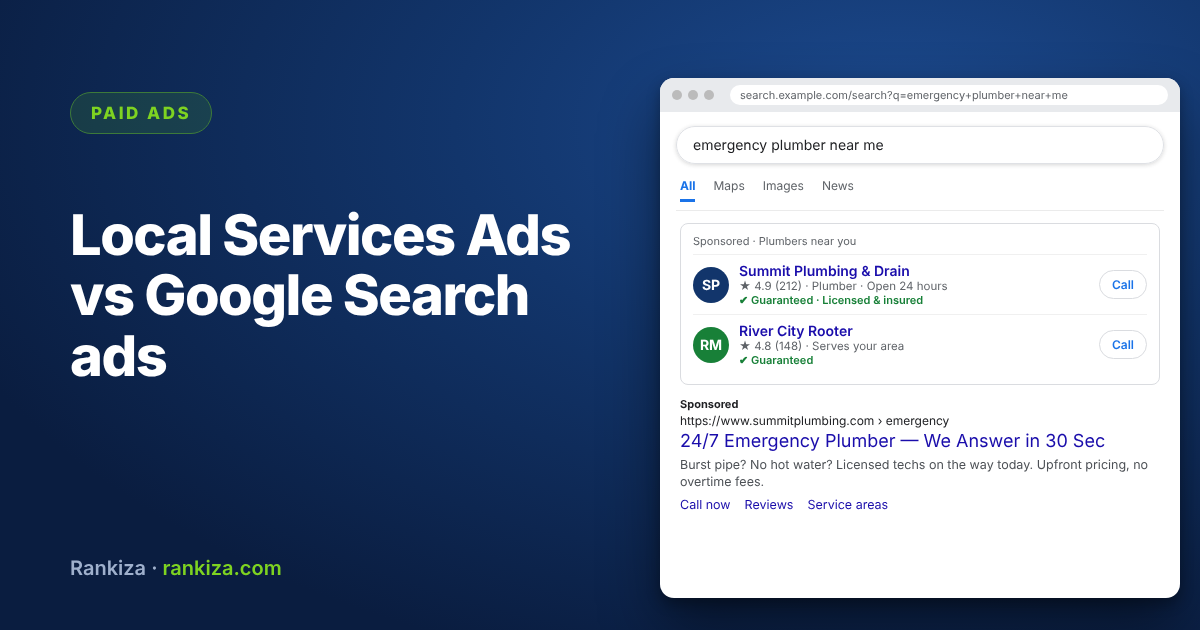
When a contractor decides to buy leads from Google, the first question is usually which ad product to use. Google offers two that matter for local services: Local Services Ads, the ones with the green badge at the very top of the page, and Google Search ads, the text ads that look like normal results with a small “Sponsored” label.
They look similar from a distance and work very differently. I have run both for home-service and tourism businesses, and the right answer depends on your trade, your market and how you handle incoming leads.
Short answer: Local Services Ads charge per lead and sit above everything else, with a verification badge, but you have little control over targeting. Search ads charge per click and give you full control of keywords and messaging, but need more management. Many contractors end up running both.
How Local Services Ads work
Local Services Ads, often shortened to LSA, appear at the top of the results for supported categories such as plumbers, electricians, HVAC and garage door companies. They show your business name, rating, review count, hours and a call button, usually with a Google Guaranteed or Google Screened badge once you pass verification.
- You pay per lead, not per click. A lead can be a phone call, a message or a booking request, depending on the category.
- Verification comes first. Google checks your business, and in many categories your license, insurance and background checks. It takes time, and requirements differ by state and category.
- You set a budget, but you do not choose keywords. Google decides which searches your ad appears for, based on the services and area you set.
- You can dispute leads that are clearly invalid, such as wrong service, spam or outside your area, and request a credit.
Ranking in LSA depends on several factors Google lists publicly, including review quantity and rating, how fast you respond to leads, how close you are to the customer, your business hours and how complete your profile is. In other words, it rewards the same habits that help your Google Business Profile, plus answering quickly.
How Google Search ads work
Search ads are text ads that appear when someone types a query that matches the keywords you bid on. You write the headlines and descriptions, choose the keywords, set the area and schedule, and pay each time someone clicks.
- You pay per click, whether or not that click turns into a call or a form.
- You control targeting. Keywords, locations, days, hours, devices and negative keywords are all in your hands.
- You control the message. You decide what the ad says and which page it sends people to.
- It needs management. Poor keyword choices and missing conversion tracking can burn a budget quickly.
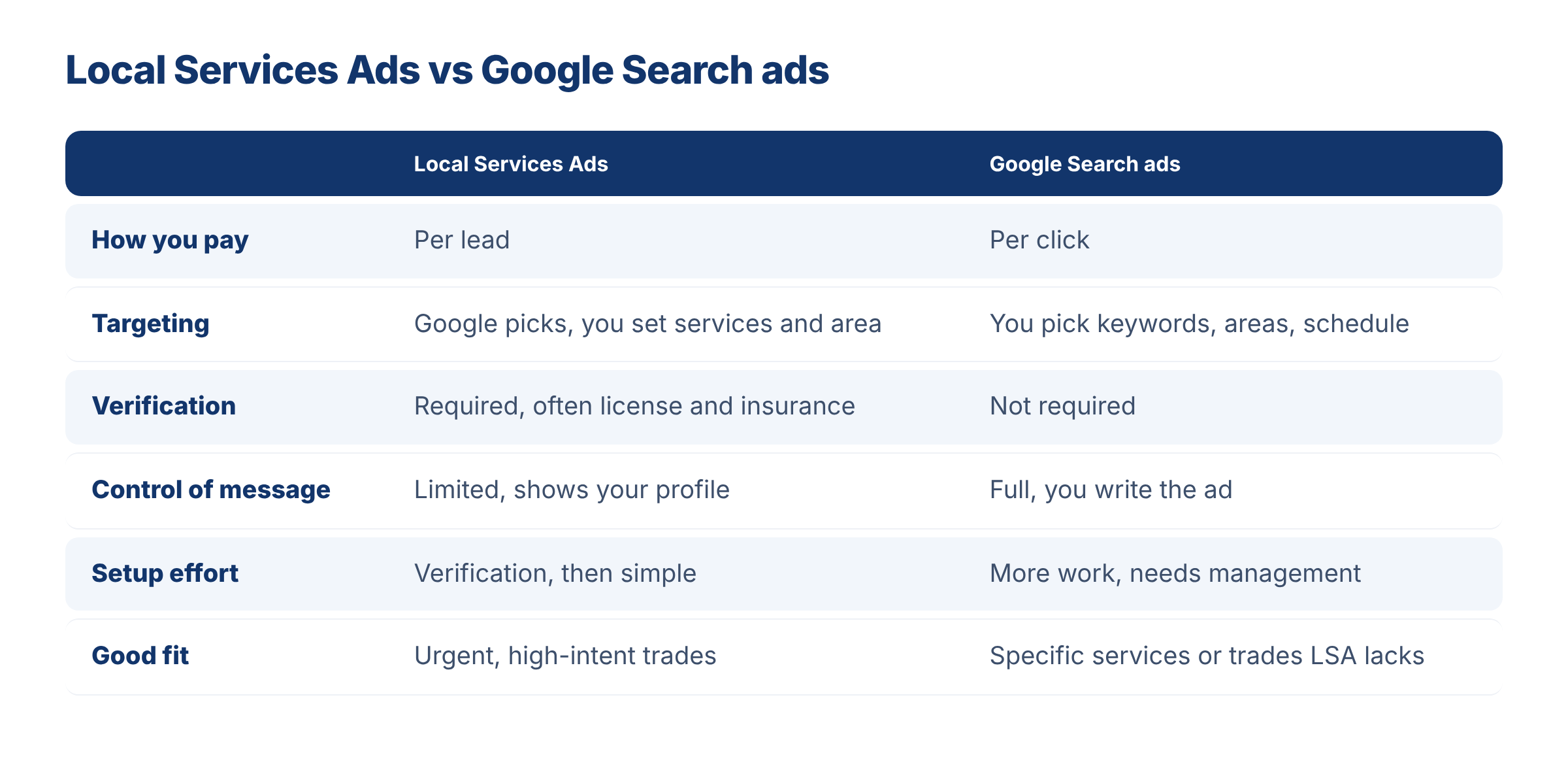
Which one fits which situation
When Local Services Ads tend to win
- You run an emergency or high-intent trade, like plumbing, HVAC, electrical or locksmith work, where people want a call right now.
- You have strong reviews and can answer the phone quickly.
- You want a simple way to buy leads without managing keywords.
- Your category and area are supported and you can pass verification.
When Search ads tend to win
- Your trade is not supported by LSA, or your area is not covered.
- You sell specific, higher-value jobs and want to target them by keyword, such as a full roof replacement or a whole-home repipe.
- You want to control the page people land on and test different offers.
- You want to capture searches that LSA does not show for.
When to run both
Plenty of contractors run both. LSA captures the urgent calls with the badge at the top, and Search ads cover specific services, areas and keywords that LSA does not. If your budget is small, start with one and add the second once you can tell the first is working.
What it costs
I do not quote prices for either product, because lead and click costs vary a lot by trade, city and season. A lead for an emergency plumber in a large metro area costs more than a lead for a lawn care company in a small town. The sensible way to plan is to decide what a booked job is worth to you, work out how many leads it takes to book one, and set the budget from there.
For a sense of how Search ad numbers look in practice, the e-bike rental company I have managed since 2021 has recorded 29,940 clicks and 2,154 conversions from Google paid ads, at about $27.95 per conversion, as shown in the e-bike rental case study. That is a tourism business, so the numbers will not match a plumber’s, but it shows what a campaign tuned over several years can look like.
The mistakes that waste ad budget
- No conversion tracking. If you do not count calls and form submissions, you are guessing.
- Broad keywords without negatives. You end up paying for searches like “plumber jobs” and “how to fix a leak yourself”.
- Sending all clicks to the home page. A page about the service searched converts better.
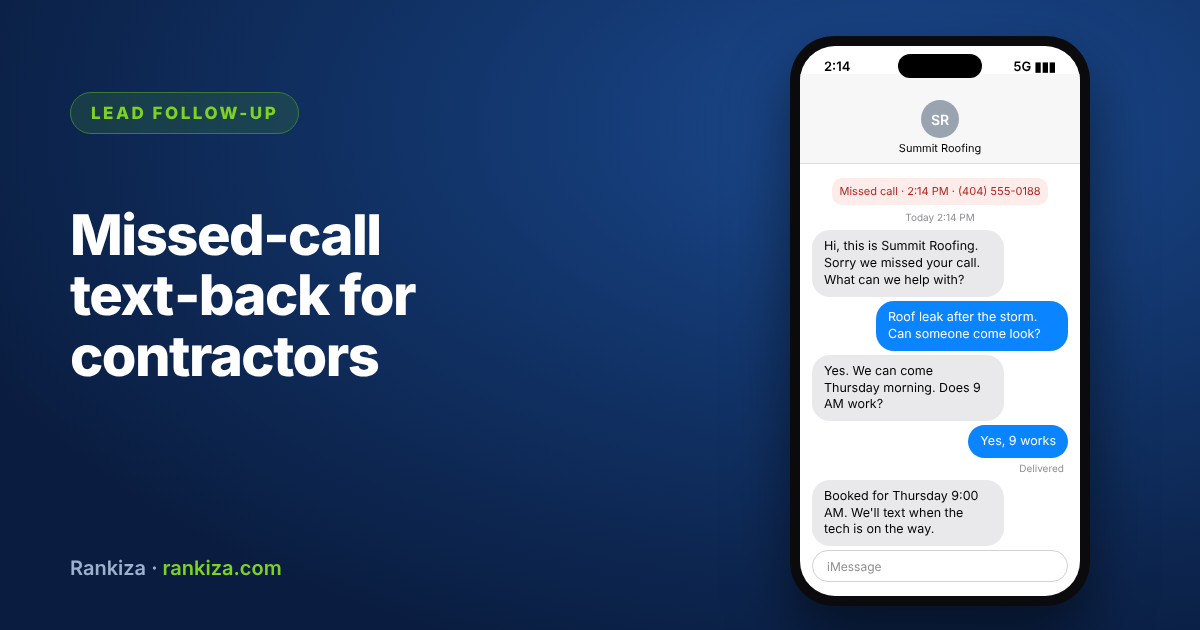
- Letting calls go unanswered. Paid leads that reach voicemail are the most expensive kind of missed call. A text-back system helps recover them.
- Ignoring the lead quality. Check the leads. Dispute the bad ones in LSA, and add negative keywords for Search.
On the beach rental account, a big part of the early work was removing campaigns and keywords that were not relevant, then fixing conversion tracking so the numbers could be trusted. You can read more in the beach rental case study.
What about Meta ads?
Facebook and Instagram ads work differently. People are not searching, so you are interrupting them rather than answering a need. They work well for services where you can show a before-and-after, offer a seasonal special or reach a defined audience, and poorly for pure emergencies. I treat them as a separate channel from Google, with their own budget and measurement. The Google and Meta paid ads page explains how I run both.
What I’d do first
- Check if your trade and area are supported by Local Services Ads and what verification requires.
- Decide what a booked job is worth to you, and how many leads it takes to book one.
- Set up call and form tracking before spending anything.
- Start with the ad type that fits your trade, and review the lead quality weekly for the first month.
Frequently asked questions
Are Local Services Ads better than Google Ads for contractors?
Neither is better in every case. LSA suits urgent, high-intent trades and charges per lead. Search ads give more control and suit specific services or trades LSA does not cover. Many contractors run both.
Do Local Services Ads charge per click?
No. You pay per lead, such as a call, message or booking request, depending on the category. Search ads charge per click.
Do I need a license to run Local Services Ads?
Requirements depend on your trade and state. Google verifies your business and, in many categories, your license, insurance and background checks before the badge appears.
Can I run Local Services Ads and Search ads together?
Yes. Running both lets you capture urgent calls through LSA and target specific services and areas with Search ads.
I'll check your website, Google profile, phone setup, follow-up, reviews, and ads and tracking. Free, no obligation.
Get my free audit
Growth marketing consultant for US home-service contractors. In digital marketing since 2012, 60+ businesses, $1.4M+ ad spend managed. More about me.