You are on a roof, under a sink or in a crawl space. The phone rings, you cannot reach it, and the caller hangs up without leaving a voicemail. Ten minutes later you call back and get someone who already booked another contractor.
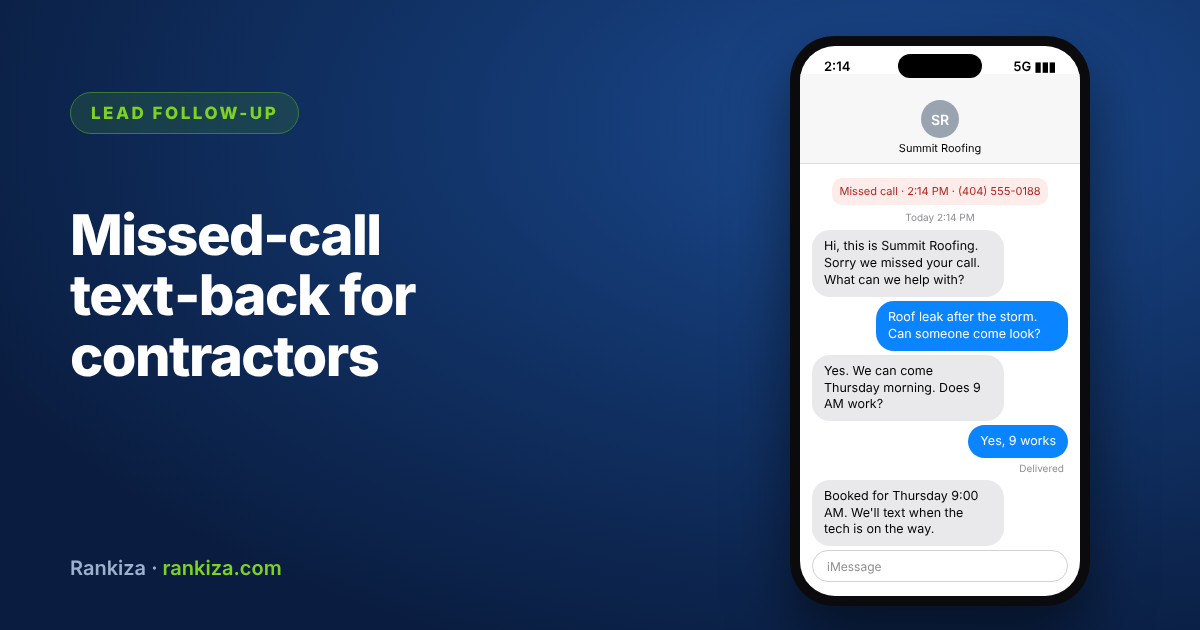
A missed-call text-back is the simplest fix for this. When a call goes unanswered, the caller gets a text within seconds, starting a conversation you can pick up when your hands are free. It is the first piece of the Lead Follow-Up System I set up for contractors, and it is usually the one that pays for itself first.
Short answer: A missed-call text-back automatically texts a caller within seconds of a missed call, asking what they need. It keeps the lead from moving on to the next contractor, and lets you reply when you are free. It needs a business number that can text, a short message and proper opt-out handling.
Why missed calls cost more than they look
Most owners know they miss calls. Few know how many, or what those calls were worth. A missed call from an existing customer is an annoyance. A missed call from a stranger who found you on Google is a lost job, and often one you paid to get, through ads, a website or years of building your listing.
Here is a simple way to estimate the cost. These numbers are an illustration, not a benchmark, so replace them with your own:
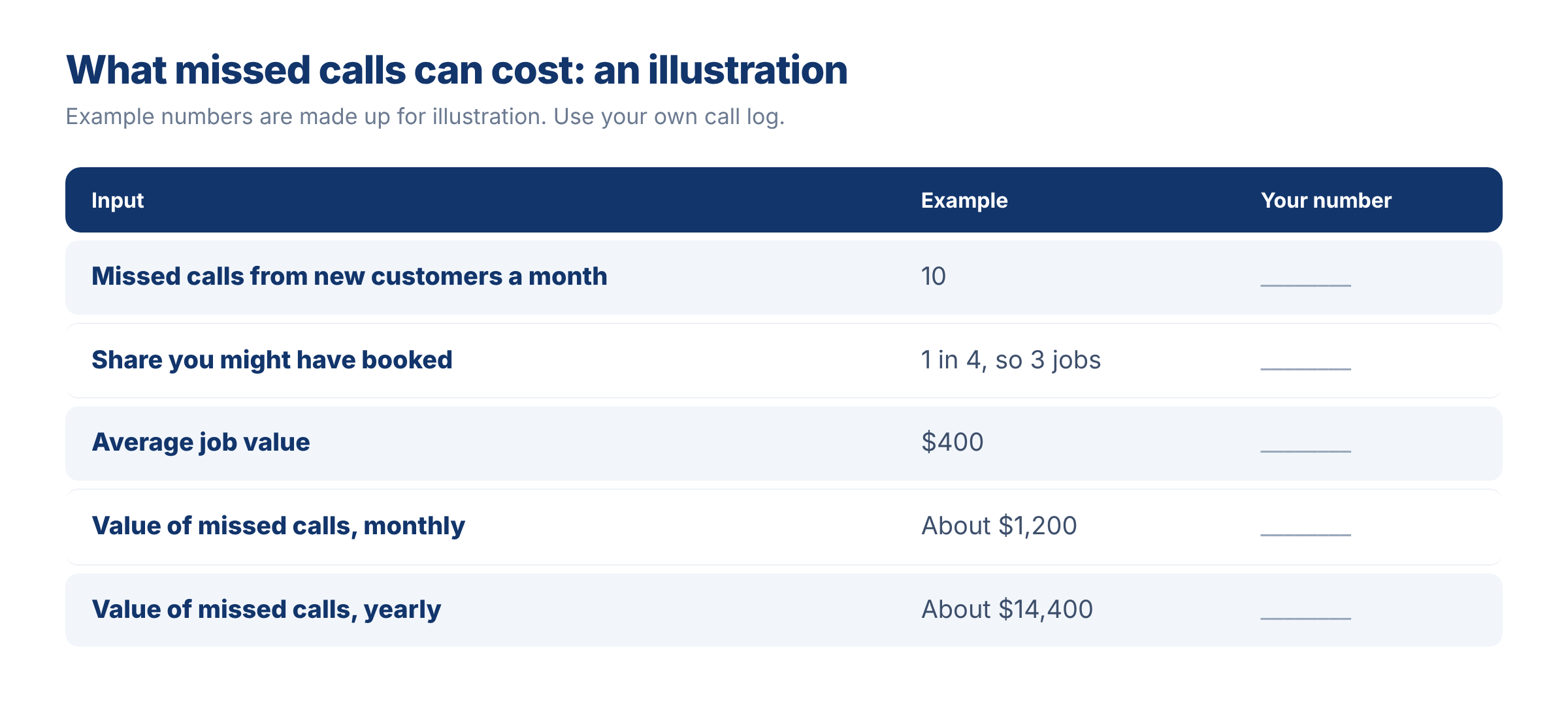
- Missed calls from new customers per month: 12
- Share you might have booked if you had answered: 1 in 4, so 3 jobs
- Average job value: $400
- Monthly value of those calls: about $1,200, or $14,400 a year
The point is not the exact figure. It is that a few lost calls a month adds up to something worth fixing. You can pull the real number from your phone’s call log in about ten minutes.
How a missed-call text-back works
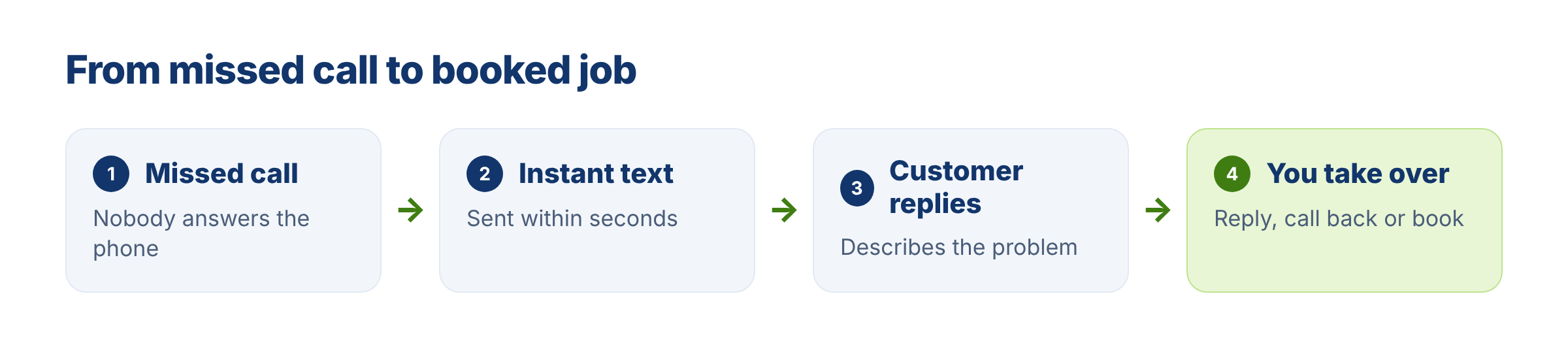
- A call comes in and nobody answers. Your phone system detects the missed call.
- A text goes out within seconds. It comes from your business number and introduces you.
- The customer replies. They describe the problem in their own words.
- You or your team take it from there. A reply, a call back or a booking link.
In my setups, the replies land in one inbox together with web forms, Messenger and Instagram messages, so nothing sits in four places. Follow-up on open quotes uses the same inbox.
What to say in the text
The best messages are short, human and ask one question. Here are three versions that work, depending on your trade:
General: “Hi, this is [Company]. Sorry we missed your call. What can we help with?”
Emergency: “Hi, this is [Company]. We are on a job and missed your call. If this is urgent, reply with your address and the problem and we will get back to you right away.”
Estimate: “Hi, this is [Company]. Thanks for calling. What kind of project are you planning? We can set up a time for an estimate.”
A few rules of thumb:
- Say your company name so the customer knows who is texting.
- Ask one question. Do not send a paragraph.
- Do not include a price or a sales pitch.
- Reply fast when the customer answers. The text buys you a few minutes, not an afternoon.
What you need to set it up
- A business phone number that can send texts. This is usually a number through a business texting or CRM platform, forwarded to your cell.
- Call forwarding or a missed-call trigger. The system has to know when a call was not answered.
- A shared inbox. Replies should reach whoever handles leads, not sit on one person’s phone.
- Business hours and an after-hours message. A text at 11 PM should say when you will reply.
- Registration for business texting. In the US, texting from a standard 10-digit business number requires registering your business with the carriers, known as A2P 10DLC. Your texting platform should walk you through it, and it can take days, so start early.
The rules to follow
I am not a lawyer and this is not legal advice, but a few practices are standard. The caller contacted you first, which helps, and you should still keep texts limited to the reason they called. Include your business name, honor opt-outs such as STOP right away, avoid sending marketing texts to people who did not agree to receive them, and keep a record of consent where you collect it. Consent and messaging terms should be written in plain language on your site; mine are on the SMS consent page. Check with a lawyer for your situation, especially if you plan to send promotional texts later.
Common mistakes
- A robotic message. “Thank you for contacting us. Your call is important to us” sounds like a phone tree. Sound like a person.
- No one watches the replies. A text-back is the start of a conversation, not a replacement for one.
- Texting existing contacts by mistake. Exclude suppliers, staff and family numbers.
- Skipping registration. Unregistered business texting can be filtered or blocked.
- Not measuring. Track how many missed calls turn into replies and booked jobs, as in my monthly measurement routine.
How it fits with the rest of your marketing
A text-back does not create new leads. It protects the ones you already paid for. It is most valuable when your Google listing and your website are bringing people in, as I describe in how homeowners choose a contractor in an emergency, and when paid ads add volume, as in the guide to Local Services Ads and Search ads. If you want to see it in action, the home page has an example conversation, and the free Lead Leak Audit checks what happens to your own missed calls today.
What I’d do first
- Pull your phone log for the last 30 days and count missed calls from numbers you do not recognize.
- Choose a business texting number and register it for A2P 10DLC.
- Write one short message in your own voice and set it to send after a missed call.
- Decide who watches the inbox, and set a target of replying within a few minutes in business hours.
Frequently asked questions
What is a missed-call text-back?
It is an automatic text message sent to a caller within seconds of a missed call, usually asking what they need. It starts a conversation that you can continue when you are free.
Does missed-call text-back really work?
It helps because most callers in a hurry will not leave a voicemail. A quick text gives them a reason to wait, and many reply. Results depend on how fast you respond after the first reply.
Is missed-call text-back legal?
Rules depend on your situation, so check with a lawyer. As a general practice, text only people who called you, include your business name, honor opt-outs such as STOP and register your number for business texting.
Do I need a special phone number?
You need a number that can send and receive business texts, usually through a texting or CRM platform, and in the US it should be registered for A2P 10DLC.
I'll check your website, Google profile, phone setup, follow-up, reviews, and ads and tracking. Free, no obligation.
Get my free audit
Growth marketing consultant for US home-service contractors. In digital marketing since 2012, 60+ businesses, $1.4M+ ad spend managed. More about me.