A homeowner with water coming through the ceiling does not compare six companies. They pick up a phone, search, and call the first business that looks real and open. If nobody answers, they call the next one. The whole decision often takes a few minutes, and most of it happens before they ever see your website.
I have spent years looking at this from the contractor side, on accounts for HVAC, plumbing, roofing and home inspection businesses, and the pattern is the same in every trade. This post walks through what an emergency buyer actually looks at, in the order they look at it, and what you can control at each step.
Short answer: In an emergency, homeowners choose from the top few Google results in minutes, based on whether the business looks open, trusted and close. They call the first one that answers. Your listing, your reviews and your phone are the sales process.
The first five minutes of an emergency search
An emergency search is different from a planned one. Someone replacing a roof in spring may read reviews for a week. Someone whose furnace quit on a cold night wants a person on the phone now. They are not looking for the best company in the city. They are looking for the first company that seems good enough and will pick up.
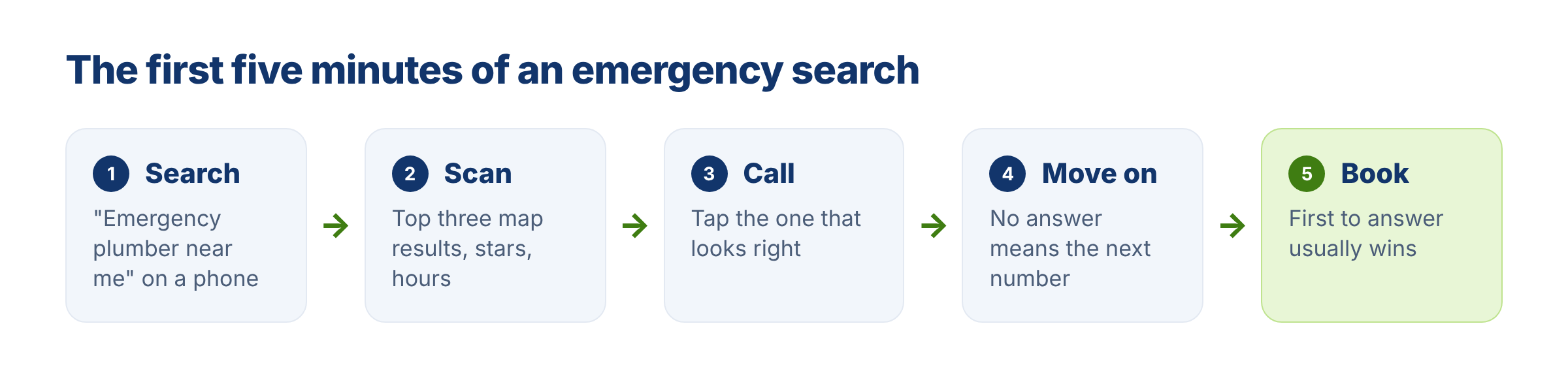
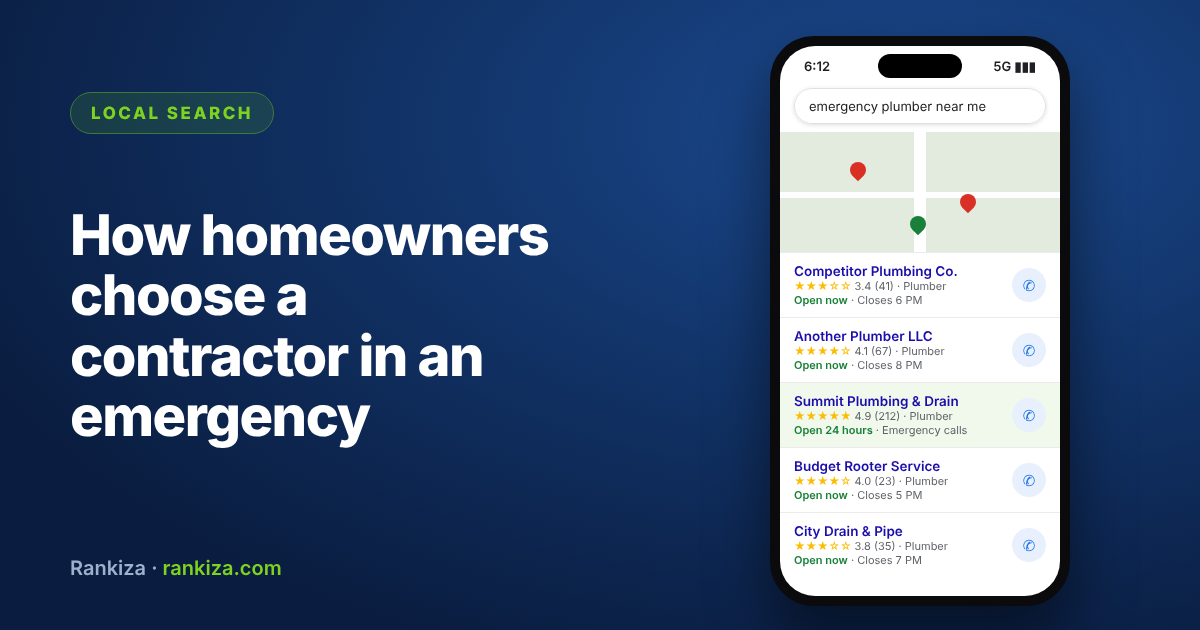
- Search on a phone. Something like “emergency plumber near me” or “AC repair open now”.
- Scan the top three map results. Google shows a short list with stars, review counts, hours and a call button.
- Tap call on the one that looks right. Most people never scroll past the first screen.
- Move on if nobody answers. Voicemail is a closed door at this stage.
- Book with whoever picks up. The winner is often the first to respond, not the cheapest.
Every step in that list can be influenced. None of them need a big budget, but they do need someone paying attention.
Step 1 and 2: how you get into the top three
Google describes local ranking as a mix of relevance, distance and prominence. Relevance is how well your listing matches what was searched. Distance is how far you are from the person, or from the area they named. Prominence is how well known you look, which is driven by reviews, links, mentions and your overall web presence.
You cannot move closer to every customer, but you can control the other two. A few things that matter more than most owners expect:
- Your primary category. “Plumber” and “Emergency plumber service” are not the same thing. The primary category carries the most weight, so choose it carefully and use secondary categories for the rest of what you do.
- Hours that match reality. If you take emergency calls, say so, and set the hours accordingly. A listing that shows as closed at 9 PM loses the late-night search.
- A real service area. List the cities you work in, not a whole state.
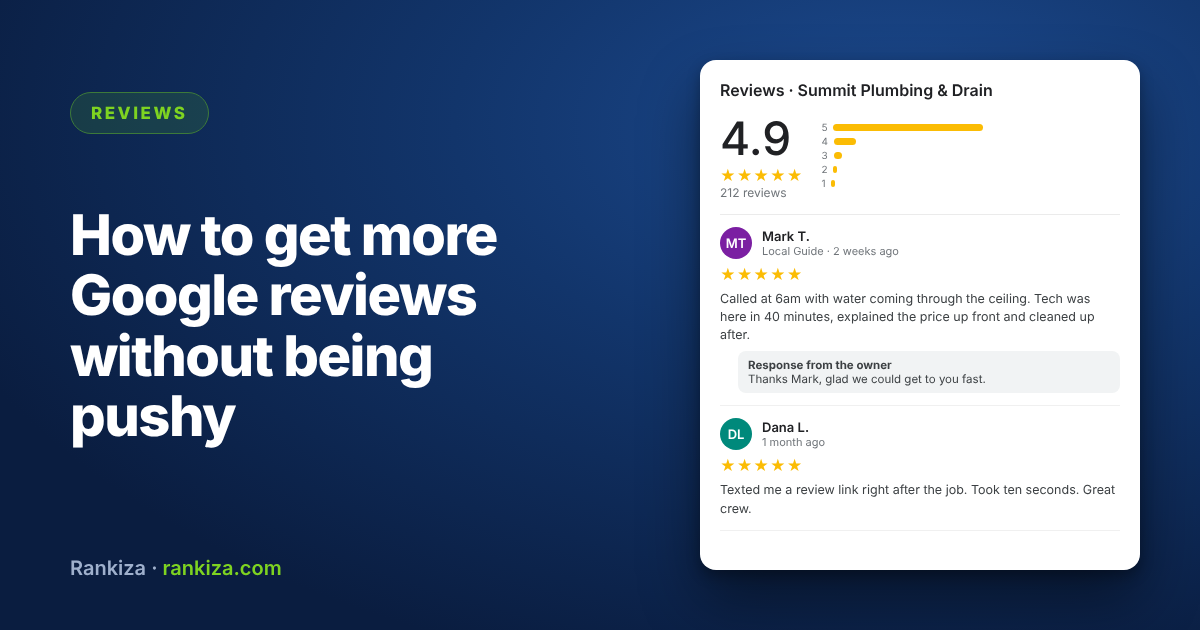
- Review volume and recency. A steady flow of recent reviews tells both Google and the homeowner that you are active. I cover this in how to get more Google reviews without being pushy.
I go through the setup details in the Google Business Profile guide for contractors.
Step 3: what homeowners check before they tap call
People decide on a few signals that take two seconds to read. Here is how they map to things you control.
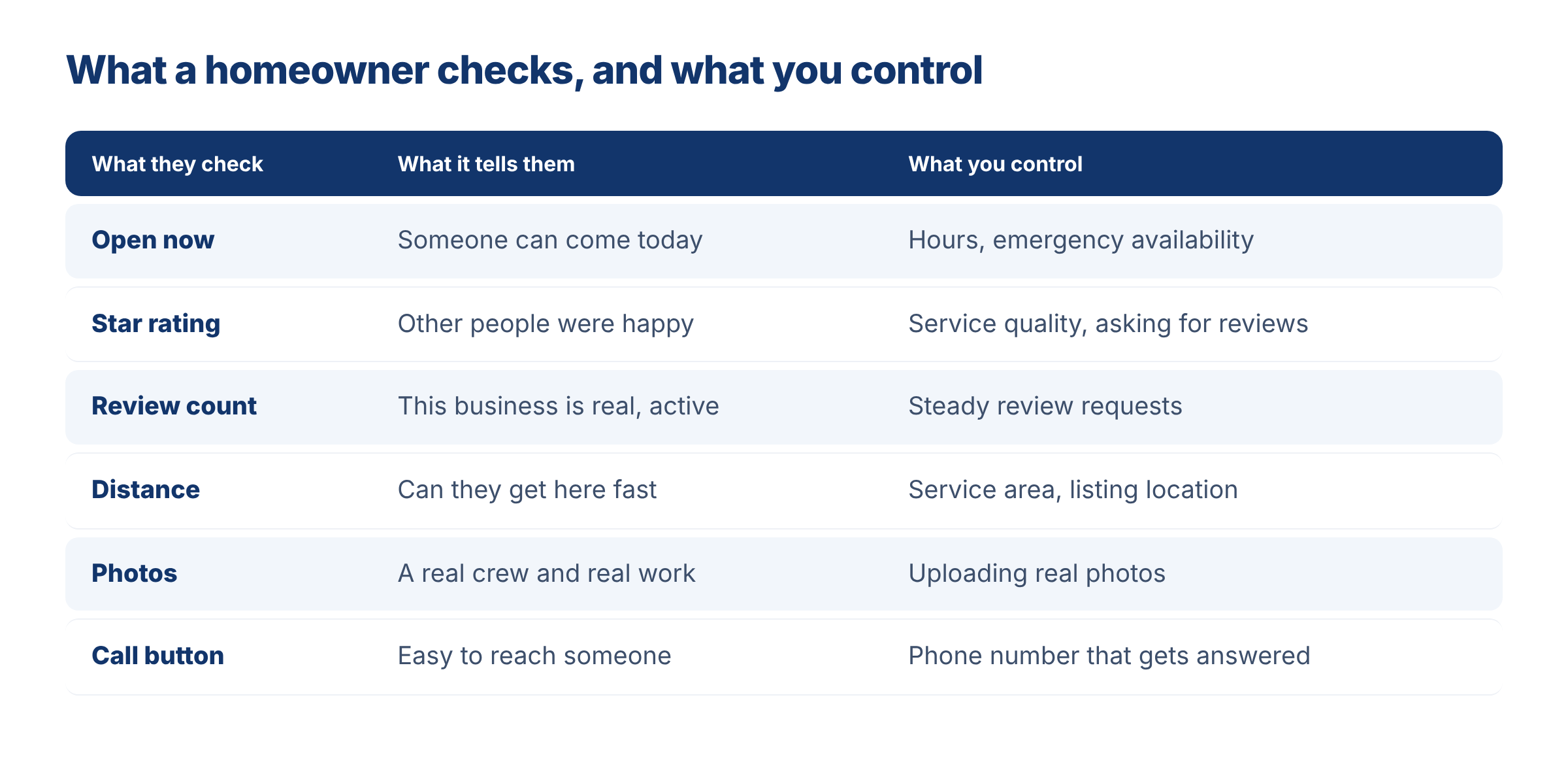
Notice what is not on that list: price lists, long about pages and brand stories. Those matter later, for a larger job or a repeat customer. In an emergency, the decision comes down to trust and availability.
Step 4: the missed call is where most jobs are lost
This is the part most contractors underestimate. You can do everything right on the listing and still lose the job because you were under a sink when the phone rang. The homeowner does not leave a voicemail. They tap the next number.
One of the websites I built and managed for a beach rental business shows how much search turns into phone calls. Over its tracking period, the site recorded 255 click-to-call taps, and 162 of those came from organic search, about 63.5%. You can see the full breakdown in the beach rental case study. That is a seasonal tourism business, not an emergency trade, but the behavior is the same: people search on a phone and tap the number.
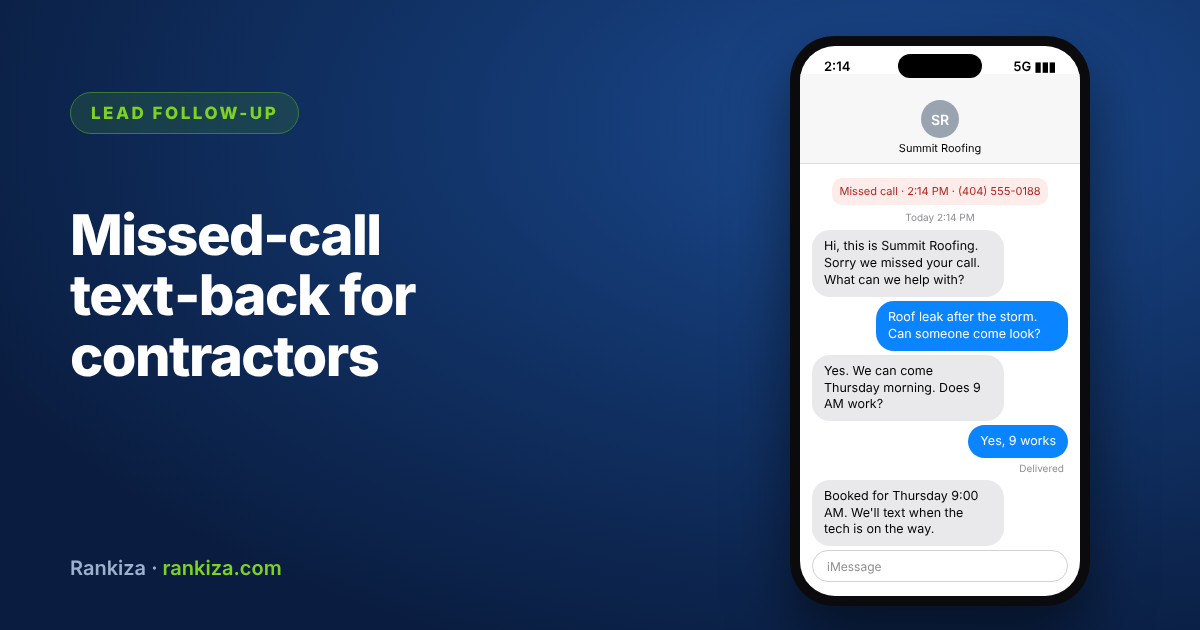
For a contractor, those taps are the most valuable events on the website. Every one that goes unanswered is a lead you paid for with your ad budget or with years of building your Google presence. A missed-call text-back that goes out within seconds keeps the conversation alive. A short message like “Sorry we missed your call, what can we help with?” gets a reply from many people who would otherwise have moved on.
Step 5: why speed beats price in an emergency
When the situation is urgent, people compare risk, not price. They want to know that someone is coming and that the company is legitimate. The business that responds first, sounds calm and gives a clear window usually wins, even if another company would have been cheaper. That is why a fast text and a clear “we can be there Thursday morning” beats a polished quote that arrives two hours later.
A few habits that help on the phone and in messages:
- Say the company name and your trade when you answer.
- Ask for the address and the problem in one sentence.
- Offer a specific arrival window, not “as soon as we can”.
- Send a confirmation text so the customer has something to hold on to.
What planned jobs look like
Not every customer is in a hurry. Roof replacements, remodels, solar and similar jobs involve more research, more quotes and more reading. For those, the website, the case studies, the reviews and the way you handle the estimate matter much more. The emergency path above is the front door for trades like plumbing, HVAC and electrical, while planned work has a longer path with the same starting point: a local search and a first impression.
If you are not sure which of the two you are, look at your last twenty jobs. How many started with a call from a stranger who needed help that day?
What I’d do first
- Search your main service plus “near me” on your phone, in the city you want to win, and write down who shows up in the top three.
- Open your own Google listing and fix the category, hours, service area and phone number. Check that the number rings somewhere that gets answered.
- Count your reviews from the last 90 days against the top three. If you are far behind, start a simple review request after each completed job.
- Test what happens when you miss a call. If the answer is “nothing”, set up a text-back.
If you want a second pair of eyes on where your calls go missing, the free Lead Leak Audit looks at exactly these points: your Google listing, your website and your phone setup.
Frequently asked questions
How do homeowners find a contractor when they need one right away?
Most start with a Google search on their phone, such as “emergency plumber near me”. They look at the top few map results, check the stars, review count and whether the business is open, and call the one that looks most trustworthy.
What matters most to a homeowner choosing an emergency contractor?
Availability and trust. They want a business that looks open now, has recent reviews and answers the phone. Price usually comes after they have someone on the line.
Why do contractors lose jobs they should have won?
Often because the call goes unanswered. Homeowners rarely leave voicemails in an emergency, so a missed call usually means the next company on the list gets the job.
Do reviews really affect who gets the call?
Yes. Reviews are one of the main signals people read in the map results, and review quantity, quality and recency also feed the prominence part of Google local ranking.
I'll check your website, Google profile, phone setup, follow-up, reviews, and ads and tracking. Free, no obligation.
Get my free audit
Growth marketing consultant for US home-service contractors. In digital marketing since 2012, 60+ businesses, $1.4M+ ad spend managed. More about me.