A seasonal business has a problem that most marketing advice ignores. For part of the year there is very little demand, then it arrives all at once. Marketing that works in July can be a waste of money in January, and a website that looks fine in February has to handle a rush in March.
This post breaks down what I did for a beach rental company over more than three years, from January 2023 to August 2026, and what I learned about running marketing around a season. The company rents e-bikes, golf carts and bikes to visitors to a beach town. Client details are anonymous, as they are on the case study page.
Short answer: For a seasonal business, local search that keeps ranking through the quiet months, ad campaigns cleaned of irrelevant searches, and reliable tracking matter more than any single tactic. Over this account, analytics recorded about $279K in online booking revenue and 255 click-to-calls, most of them from organic search.
Where the account started
The owner has said the business was struggling when I took over its marketing. When I started in January 2023, it needed a website that could take bookings, a way to be found in local search, and ad spend that went to the right searches. The business was quiet in the off-season and picked up again in March, so there was a clear window to get things ready.
What I changed
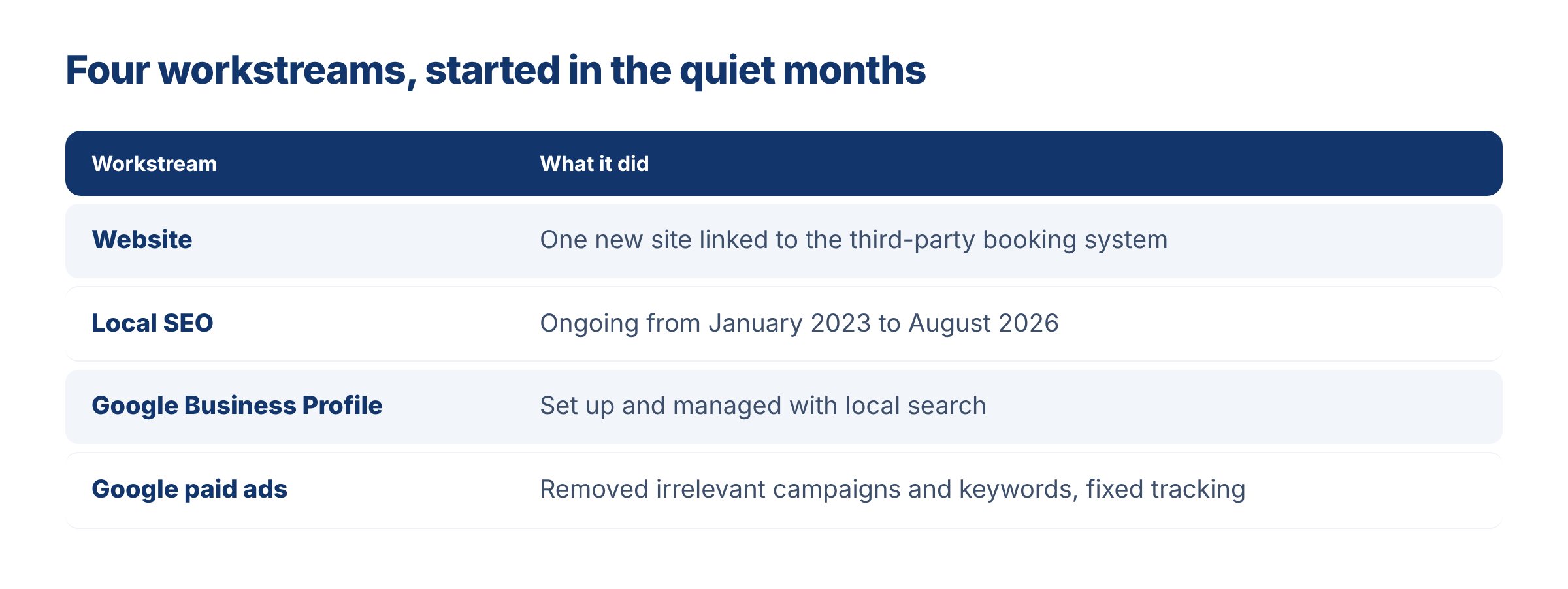
A new website linked to the booking system
I built one new site and linked it to the business’s third-party booking system. The goal was a short path: a visitor sees the rentals, picks one and moves to booking without confusion. For a business with short stays and impulse decisions, every extra click costs bookings.
Local search and the Google Business Profile
Local SEO and the Google Business Profile ran from January 2023 until the contract ended in August 2026. For tourists, the Google listing is often the first and last thing they see: reviews, photos, hours and a link to book. The work was ordinary and steady, which is typical of local search. For the setup basics, see the Google Business Profile guide.
Cleaning up Google paid ads
The ads were the part I changed first. I removed campaigns and keywords that were not relevant, then worked to fix conversion tracking and attribution so the account reported what actually happened. The owner described the result, in the testimonial on the case study page, as pulling ad spend that had been wasted. The same kind of cleanup is a common first step on a contractor account too, and it is why I recommend setting up tracking before increasing a budget, as I explain in the Local Services Ads vs Search ads guide.
The numbers
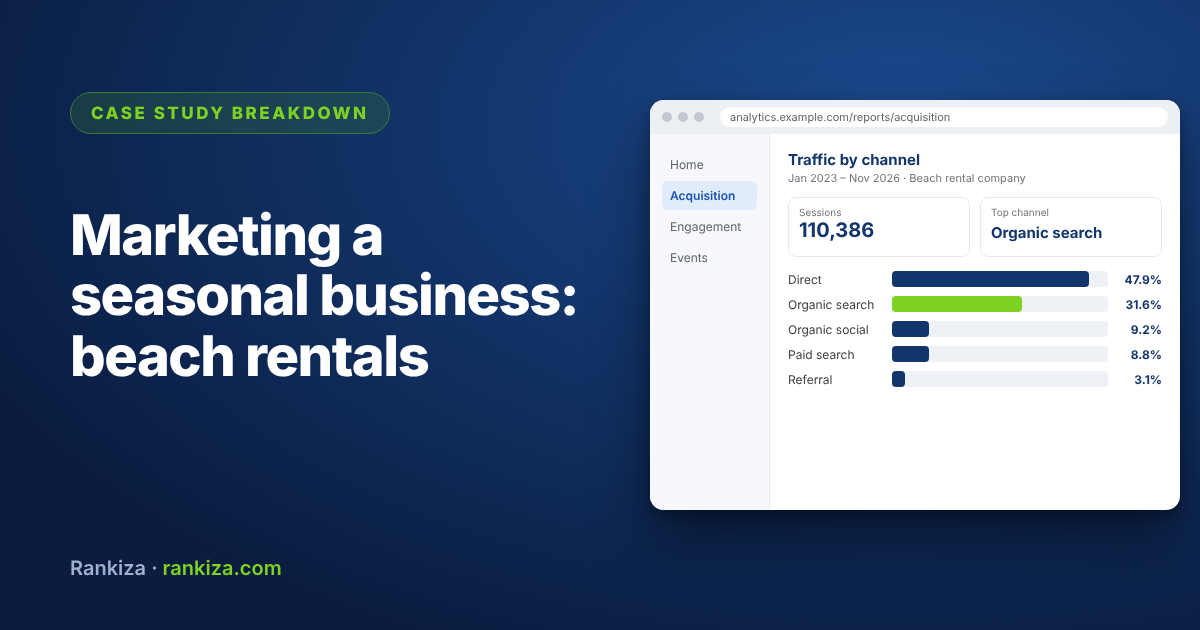
Between January 2023 and August 2026, Google Analytics recorded $278,811 in online booking revenue, with 110,386 website sessions and 255 click-to-calls by November 2026. Here is where the visits came from:
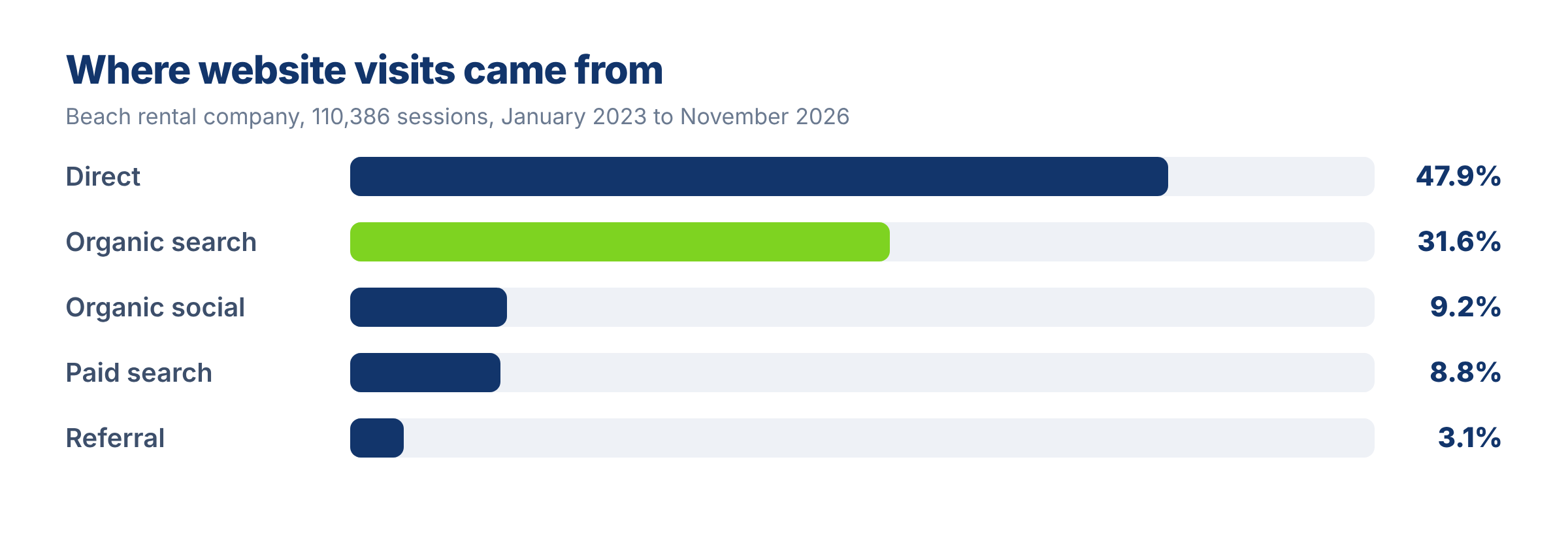
Direct traffic led at 47.9%, organic search followed at 31.6%, organic social at 9.2%, paid search at 8.8% and referral at 3.1%. Organic search produced 162 of the 255 click-to-calls, or 63.5%, and paid search produced 57, or 22.4%.
What this says about seasonal marketing
- Start in the off-season. Websites, listings and tracking should be ready before demand arrives, not rushed during it.
- Local search carries across the year. Organic search brought the most calls, and it keeps working in the quiet months when you would not want to pay for clicks.
- Paid ads need pruning. Irrelevant keywords waste the most money when demand is thin, because there is little genuine traffic to dilute them.
- Calls are a signal. Click-to-call taps showed where interest turned into action, even when the booking finished elsewhere.
- Tracking decides everything else. Without conversion tracking, you cannot tell good campaigns from bad ones.
What the data cannot show
Revenue here is online booking revenue recorded in Google Analytics when the booking system returns to the website. Booking happens on a third-party platform, so revenue appears as one total instead of by channel, and walk-in and phone bookings are not included. My access to the booking platform ended with the contract, so these figures come from analytics only. Tracking moved to Google Analytics 4 in 2023, so the first year is partial. I would rather say so than present the numbers as more complete than they are.
That limitation is a useful lesson in itself. If a booking system sits outside your control, you need to decide early what you will measure and where. I cover the general approach in how to tell if your marketing is working. If you want to compare this with a larger account, read the e-bike rental breakdown.
Contractors in trades with a busy season, such as HVAC, roofing, landscaping or pest control, face the same rhythm. You can see how I apply this to those trades on the industries page.
What to take from this
- List the months when demand is high and low, then plan the work backwards from the start of the busy season.
- Review your Google Ads search terms and remove irrelevant keywords before increasing the budget.
- Set up conversion tracking for calls and bookings, then check it works.
- Make sure your Google Business Profile is complete, with photos and accurate hours for each season.
Frequently asked questions
How do you market a seasonal business?
Prepare in the quiet months, keep local search and your Google profile strong all year, tighten paid ads so they only target relevant searches, and track calls and bookings so you can see what works.
Is local search worth it for a seasonal business?
Yes. On this account, organic search produced about 63.5% of the click-to-calls, and it keeps working in the off-season when paid clicks are less efficient.
What is the first thing to fix in Google Ads for a small business?
Check the search terms report and remove irrelevant keywords, then make sure conversion tracking counts the actions that matter, like calls and bookings.
Are these numbers a promise of what my business will get?
No. They are one business over three years, with the limits described above. Results depend on your market, season and budget.
I'll check your website, Google profile, phone setup, follow-up, reviews, and ads and tracking. Free, no obligation.
Get my free audit
Growth marketing consultant for US home-service contractors. In digital marketing since 2012, 60+ businesses, $1.4M+ ad spend managed. More about me.