Hiring a marketing company is one of the riskiest purchases a small contractor makes. The work is hard to judge, the promises are big and the contracts are often long. Many owners I speak to have been through at least one agency that took their money and left them with nothing they owned.
I am a marketing consultant, so I have a stake in this. These are the questions I would ask if I were on your side of the table, including ones I expect to be asked about my own work.
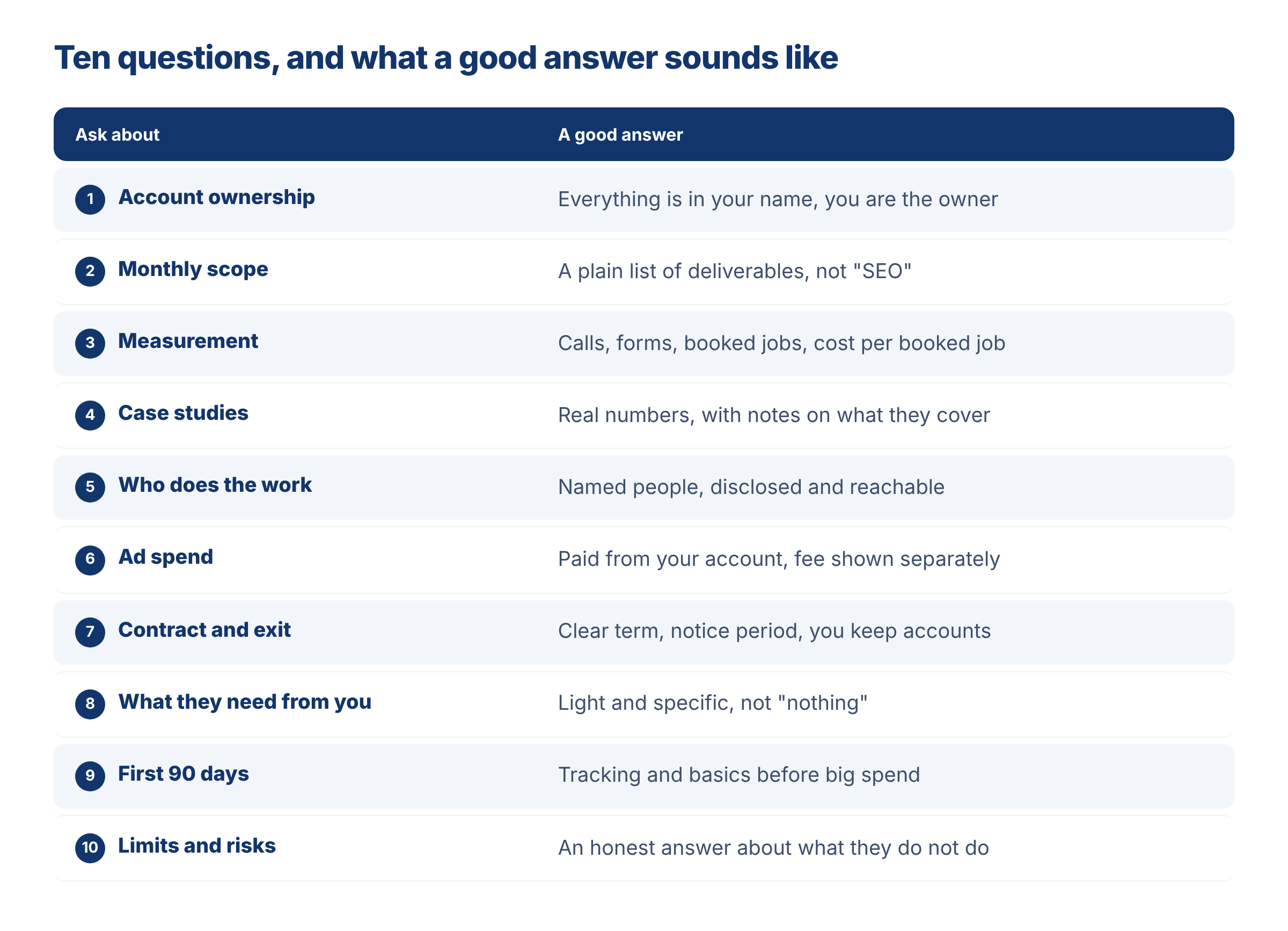
Short answer: Before you sign, ask who owns your accounts, what exactly will be done, how results will be measured in calls and booked jobs, how the contract ends and who does the work. Be careful with guarantees of rankings and with reports that cannot be tied to real jobs.
The questions
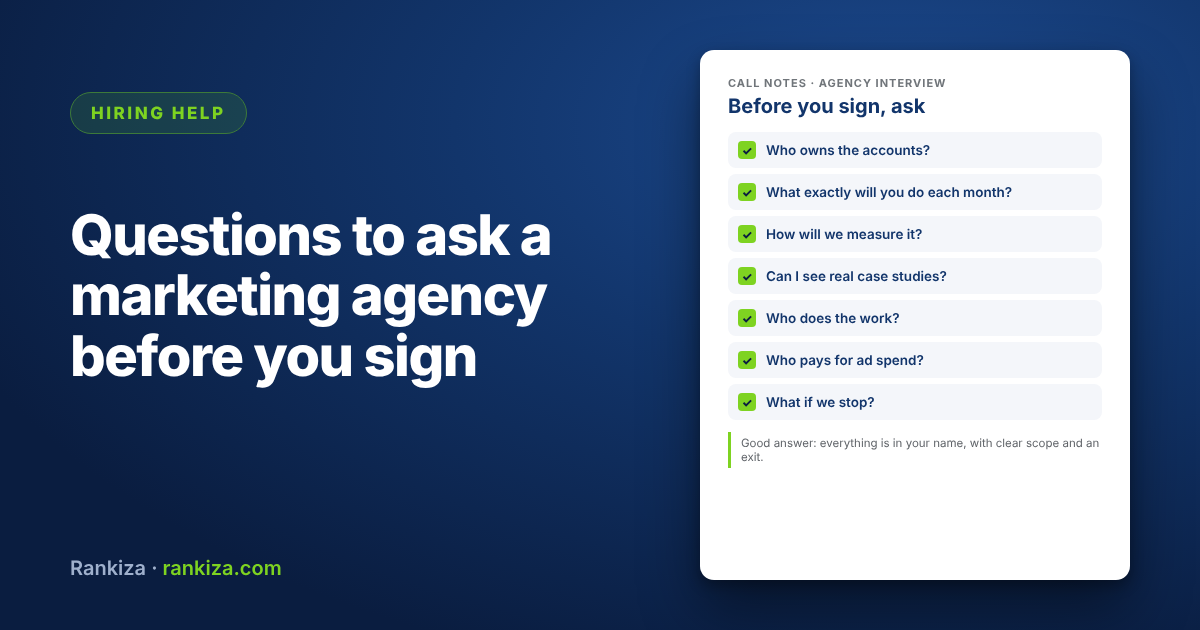
1. Who owns the accounts, the website and the domain?
This is the most important question. Your Google Business Profile, Google Ads account, Analytics, domain name and website should be in your name, with you as the owner. If you leave, you should be able to take them with you. When I set up accounts, I do it in the client’s name wherever possible and walk through ownership on the first call, so nobody is locked in without knowing it. Ask for this in writing.
2. What exactly will you do each month?
“SEO” and “marketing” are not a scope of work. Ask for a plain list: how many pages or posts, which campaigns, how often profile updates happen, who answers messages, what reports you receive. If the answer is vague, the work probably will be too.
3. How will we measure results?
Ask which numbers they will report. The useful ones are calls, forms, booked jobs and cost per booked job. If the report is mostly impressions, rankings and followers, it is a vanity report. I wrote about this in how to tell if your marketing is working.
4. Can I see real examples with real numbers?
Ask for case studies, and then ask what the numbers cover and what they do not. Honest ones say what is missing. Mine, for example, include a “how to read these numbers” note and are anonymous to protect clients, as you can see in the results section. Be wary of screenshots without context and of results from a different type of business than yours.
5. Who will actually do the work?
Some agencies sell with a senior person and hand the work to a junior or an overseas team you never meet. That can be fine if it is disclosed and managed. Ask who your contact is, who does the work and how quickly they reply.
6. How is ad spend handled?
Your ad budget should be paid to Google or Meta from an account you own, ideally on your card, so you can see every dollar. If the agency pools money or adds a hidden markup, you cannot verify what was spent. Ask what they charge for management and how it is shown separately from ad spend.
7. What are the contract length and exit terms?
Ask about the minimum term, the notice period, auto-renewal and what happens to your accounts and content when you leave. Long lock-ins are a red flag when the work is hard to judge in the first months.
8. What do you need from me?
A good partner needs access, photos, approvals and a few conversations. If the answer is “nothing”, they are either guessing about your business or doing generic work. The ask should be light and specific, as on the how it works page.
9. What is your plan for the first 90 days?
Ask what gets done first and why. A reasonable plan starts with fixing the basics: tracking, the Google profile, the website path and missed-call handling, before spending on new traffic. If the plan starts with a big ad spend and no tracking, push back.
10. What do you not do, and what could go wrong?
The honest answer to this tells you a lot. Every provider has limits. I tell clients when to improve a site instead of rebuilding it, and when a trade is not a fit for a certain channel, such as Meta ads for pure emergencies, which I describe in the guide to Local Services Ads and Search ads.
Red flags
- Guaranteed rankings or leads. Nobody controls Google. Anyone who guarantees a position is selling something else.
- No access to your own accounts. If they refuse to add you as an owner, walk away.
- Reports with no jobs in them. If you cannot connect the work to calls and bookings, you are paying for activity.
- Fake or purchased reviews. This puts your profile at risk, as I explain in the reviews guide.
- Pressure to sign today. A good provider lets you think.
- Setup fees with no deliverable. Ask what you will have in hand when they are done.
Green flags
- They ask about your jobs, your margins, your best customers and your capacity before talking about tactics.
- They tell you what they would fix first, even if it is small.
- They show where results are not clear and explain why.
- They are happy for you to own everything.
If you want a plain answer on what I would fix first for your business, the free Lead Leak Audit is a no-obligation way to see how I work. You can also read about my approach on the about page.
Before you sign
- Write down the answers to questions 1, 3 and 7 for every provider you talk to.
- Ask for accounts to be created in your name and for owner access in writing.
- Ask for a sample monthly report and check that it shows calls and booked jobs.
- Take a few days before you sign.
Frequently asked questions
What should I ask a marketing agency before hiring them?
Ask who owns your accounts, what exactly they will do each month, how results are measured, who does the work, how ad spend is handled and how the contract ends.
Should I own my website and ad accounts?
Yes. Your domain, website, Google Business Profile, Google Ads and Analytics accounts should be in your name with you as owner, so you can leave without losing them.
Is it a red flag if an agency guarantees first-page rankings?
Yes. No one controls Google results, so guarantees of position are a warning sign.
How long should a marketing contract be?
It depends, but long lock-ins are risky when results are hard to judge early. Ask about the minimum term, notice period and what happens to your accounts if you leave.
I'll check your website, Google profile, phone setup, follow-up, reviews, and ads and tracking. Free, no obligation.
Get my free audit
Growth marketing consultant for US home-service contractors. In digital marketing since 2012, 60+ businesses, $1.4M+ ad spend managed. More about me.