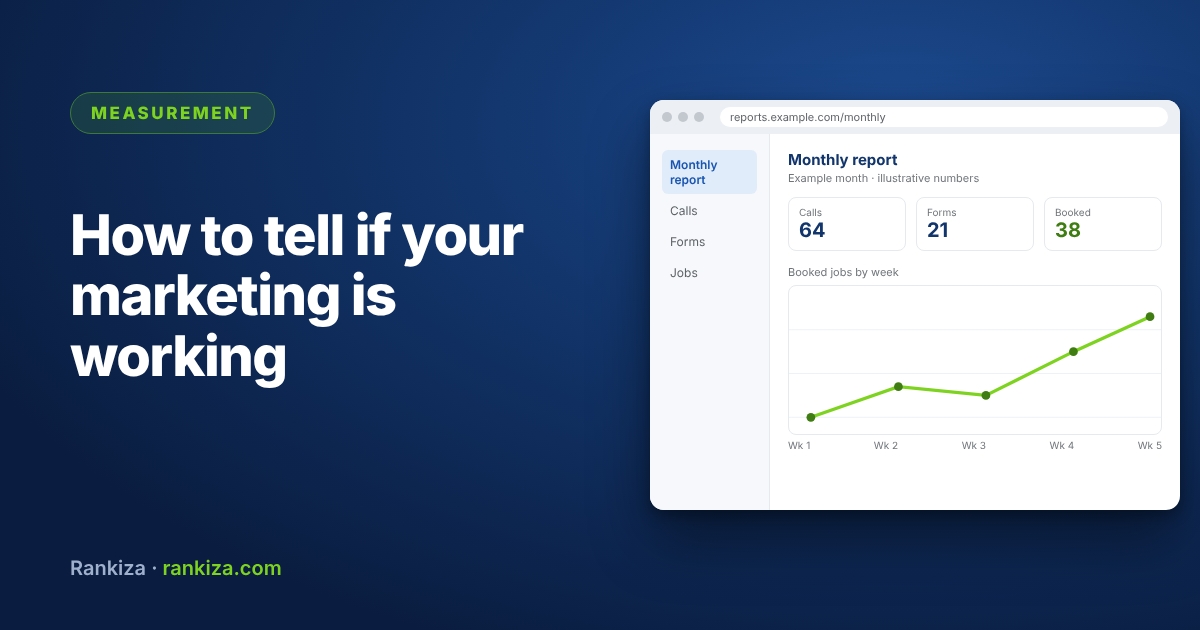
Many contractors get a marketing report each month and cannot say whether the business is better off. The report has impressions, clicks, rankings, followers and a lot of charts. It does not say how many jobs it produced.
I went out on my own partly because I kept seeing owners handed thick reports full of numbers that did not pay anyone. The fix is to measure the few things that connect to money and ignore the rest. This is the short list I use.
Short answer: Track calls, form submissions, booked jobs and revenue by source, then divide spend by booked jobs. Impressions, rankings and followers are only useful if they lead to those four numbers.
The chain that matters
Marketing works as a chain. Each link feeds the next, and a break anywhere stops the money.
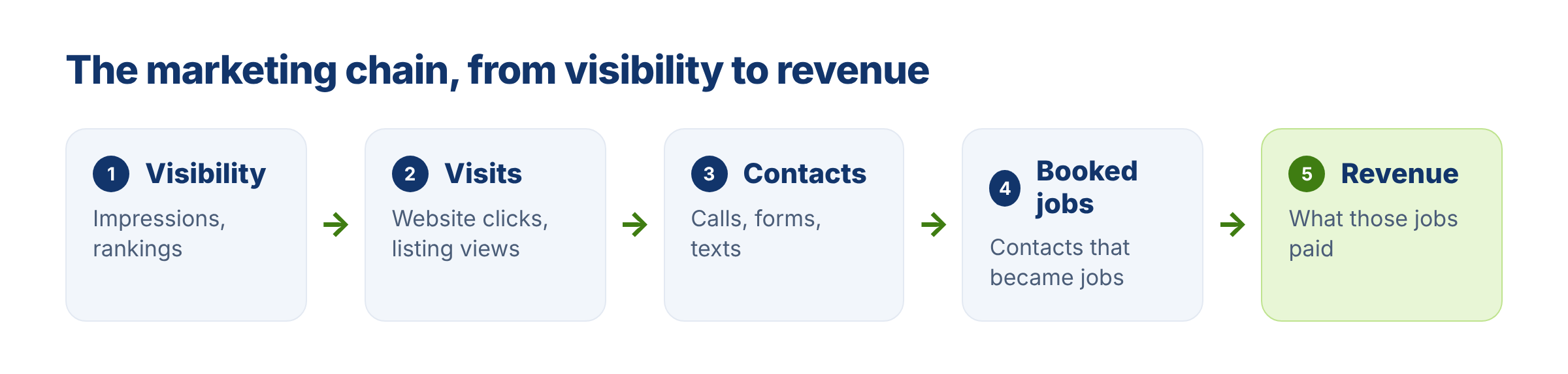
- Visibility: impressions and rankings. Interesting, but not the goal.
- Visits: clicks to the website and views of the Google listing.
- Contacts: calls, forms, texts. This is where marketing becomes measurable.
- Booked jobs: contacts that turned into scheduled work.
- Revenue: what those jobs paid.
Most reports stop at the first two. Start from the right.
The six numbers I look at every month
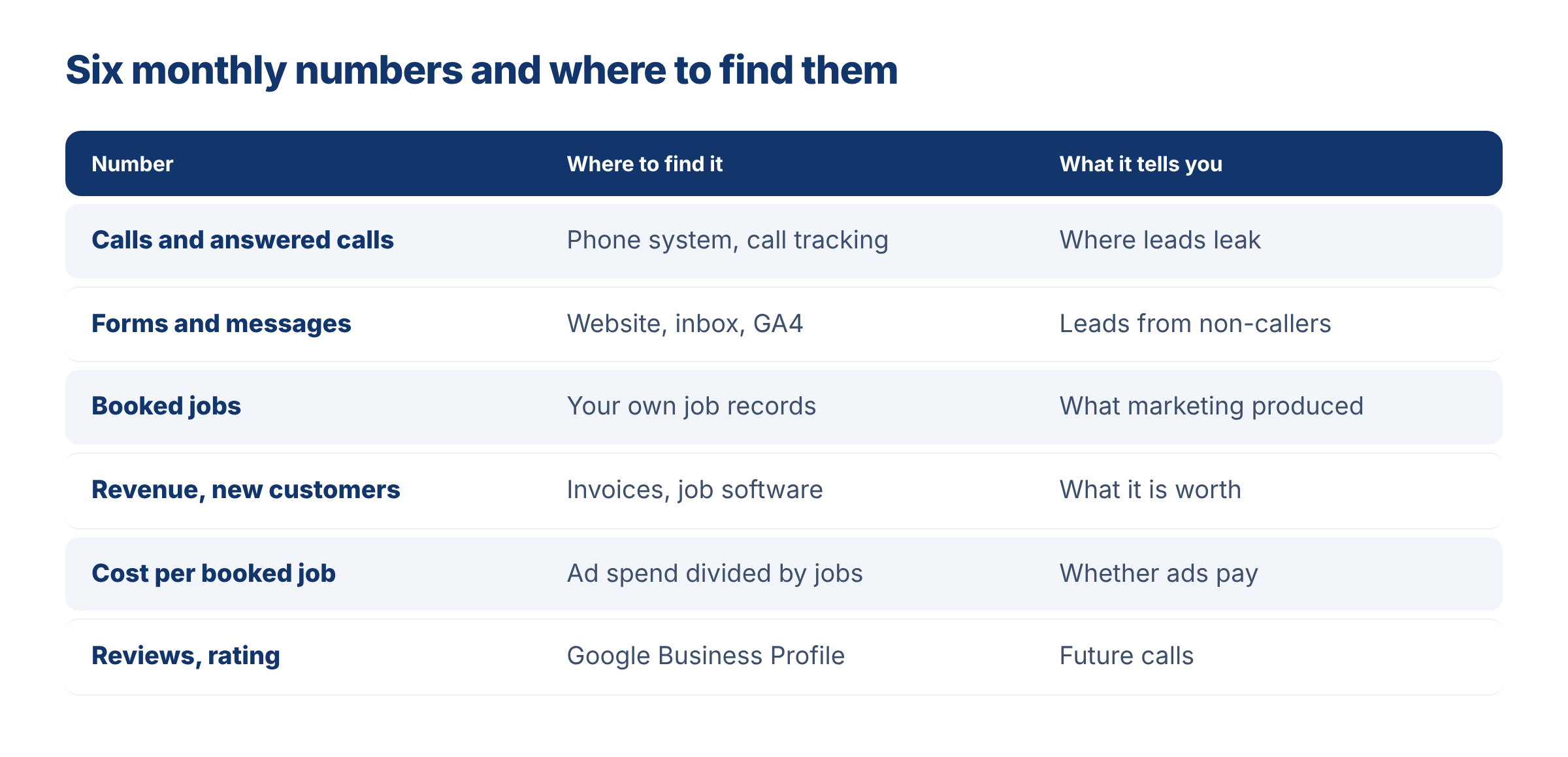
1. Calls, and how many you answered
Count calls from every source: the Google listing, the website, ads. Then count how many were answered. If you cannot see missed calls, you cannot see the leak. A call tracking number or a call log from your phone system gives you this.
2. Form and message submissions
Some customers will not call. Count forms, chat messages and texts. Check how fast you replied.
3. Booked jobs
This is the number that matters most and the one that is usually missing. Keep a simple record of where each new job came from, asked at booking: “How did you find us?” It is imperfect and still useful.
4. Revenue from new customers
Tie the job to what it paid. Do not worry about perfect attribution. A rough view, such as “about half of new revenue came from Google,” is more useful than none.
5. Cost per lead and cost per booked job
If you run ads, divide monthly ad spend by leads, then by booked jobs. The second figure tells you whether the ads are profitable. A cheap lead that never books is not cheap.
6. Review count and rating
Reviews feed future calls. Track new reviews each month against the top competitors in your area.
Where to find the numbers
- Google Business Profile: calls, website clicks, direction requests.
- Google Analytics 4: website visits, click-to-call events, form events, traffic sources.
- Google Search Console: which searches bring people to the site, and your average position.
- Google Ads and Meta: spend, clicks, conversions, cost per conversion.
- Your phone system or CRM: call logs, missed calls, replies, booked jobs.
What these numbers look like on real accounts
Two of my longest-running accounts show why a single source of truth matters. The e-bike rental company records online, walk-in and phone bookings in one booking platform, which gives one set of numbers: 4,750 bookings and about $1.12M paid by customers between April 2021 and November 2026. Website analytics add the channel view, such as organic search being the largest source of engaged visits at 29.8%. Details are in the e-bike rental case study.
The beach rental company is the opposite case. Booking happens on a third-party platform, so analytics records revenue as one total of about $279K rather than by channel, and walk-in and phone bookings are not counted. We could still see that organic search produced 162 of the 255 click-to-calls. The lesson is that you can work with imperfect data as long as you know what it covers, which is why every case study I publish includes a note on how to read the numbers. See the beach rental case study.
Common traps
- Rankings without traffic. Being number one for a search nobody makes does not pay.
- Traffic without calls. A busy website with no calls usually has a conversion problem, not a traffic problem.
- Last-click credit. Customers often see the Google listing, the website and an ad before calling. Do not give all the credit to the final touch.
- Broken tracking. If numbers suddenly jump or drop, check the setup before celebrating or panicking.
- A report nobody reads. Ask for a one-page summary in plain English.
A monthly review that takes 30 minutes
- Write down calls, answered calls, forms and booked jobs.
- Note where each booked job came from.
- Divide ad spend by booked jobs, if you run ads.
- Compare with last month and the same month last year if you have it.
- Pick one thing to change next month.
Pairing this with an answer on how homeowners choose a contractor helps you decide where to focus, and the Google Business Profile guide covers the first source of calls to check.
What I’d do first
- Set up a way to count calls and missed calls.
- Add click-to-call and form events in Google Analytics 4.
- Start asking every new customer how they found you.
- Ask whoever does your marketing for a one-page monthly summary of calls, forms, booked jobs and cost per booked job.
Frequently asked questions
How do I know if my contractor marketing is working?
Track calls, form submissions, booked jobs and revenue by source, then divide your spend by booked jobs. If those numbers rise over time, the marketing is working.
What marketing numbers should I ignore?
Impressions, follower counts and ranking positions are only useful if they lead to more calls and booked jobs. Treat them as signals, not results.
What is a good cost per lead for a contractor?
It varies by trade, city and season, so there is no universal number. Compare cost per booked job with what a job earns you.
How often should I review my marketing numbers?
Monthly is a good rhythm for most contractors. Check calls and missed calls weekly if you run ads.
I'll check your website, Google profile, phone setup, follow-up, reviews, and ads and tracking. Free, no obligation.
Get my free audit
Growth marketing consultant for US home-service contractors. In digital marketing since 2012, 60+ businesses, $1.4M+ ad spend managed. More about me.